Old Town venues featured in this article. Tap a pin for details.
For seventy years, you couldn’t order a margarita in Old Town Tomball. One restaurant owner changed that and unleashed a downpour.
A narrow rule that outlived its reason
Back in 1944, Tomball passed an ordinance declaring that no beverage over 14% alcohol could be sold in the eight-block historic center. At the time, Tomball was a railroad town with saloons catering to the rail traffic, and the rule was meant to tame them. But the railroad faded, the saloons closed, and the ordinance simply stayed on the books — no hard liquor, no margaritas, for decade after decade.
The rule outlived the railroad by generations. When Cisco’s Salsa Company opened on Commerce Street, the only legal way to pour a margarita was through a “private club” membership that expired every three days — a workaround owner Laura Wilson called unsustainable.
So in 2014, Wilson and her husband Dennis Henderson gathered more than 1,200 signatures in six weeks to force a local-option election. Voters overwhelmingly repealed the 70-year-old ban. In April 2015, Cisco’s reopened on the books as a full mixed-beverage holder — and Old Town’s bar scene was born.
You can watch the whole thing happen
Texas law (Tax Code § 111.006) keeps a business’s ordinary sales-tax remittances strictly confidential — the state will never tell you how much Kroger or the hardware store paid. But any venue that serves liquor pays a separate 14% Mixed Beverage Gross Receipts Tax, and those receipts are published per location, per month, by name and address. The bar tab is the one corner of local commerce you’re allowed to watch.
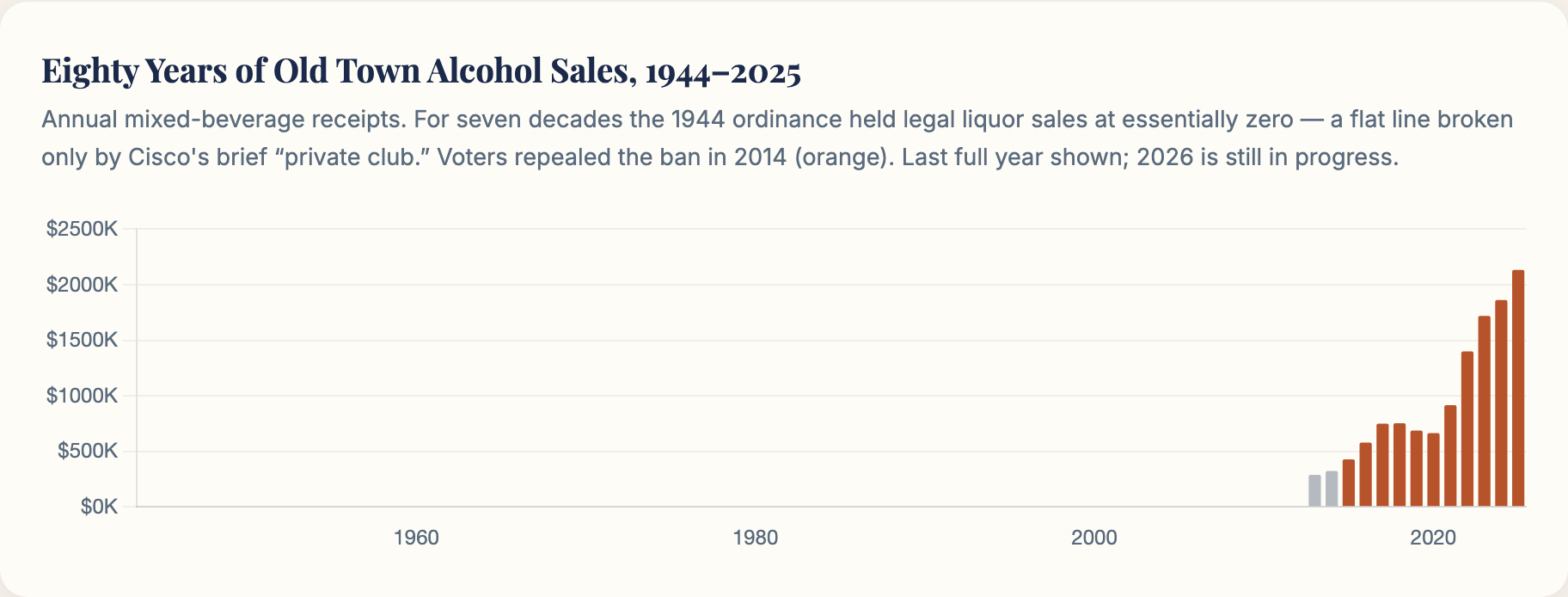
Chart eighty years of those receipts for Old Town and you get a perfect flat line — essentially zero legal liquor sales from 1944 onward, broken only by Cisco’s brief private club — and then, right after the 2014 vote, a hockey stick. One lonely venue reporting alcohol sales before the election; more than ten today. Old Town’s mixed-beverage receipts in 2025 came to roughly $2.1 million, about 7.4 times what the district reported in 2013. This past March set the single-month record: nearly $252,000 in one month.
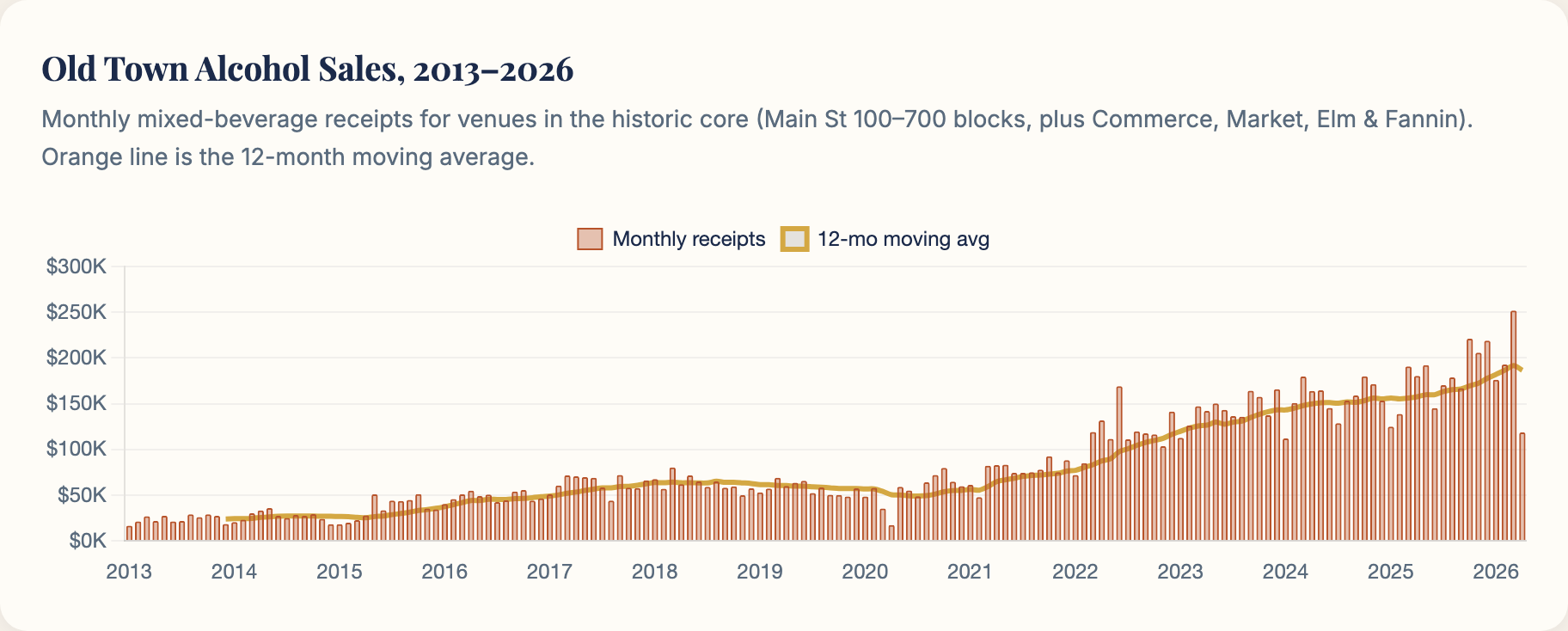
The monthly view tells the same story up close — a slow climb through the 2010s, then a steepening line that keeps setting records into 2026.
Who actually pours the most
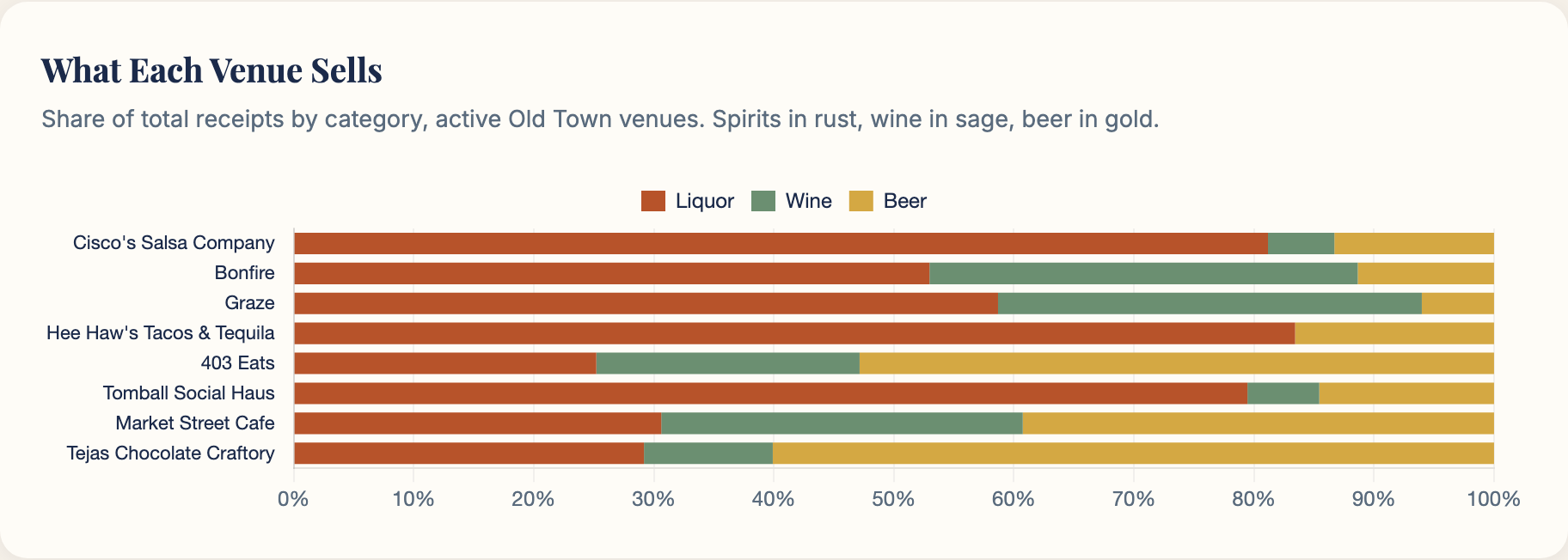
Rank the active Old Town venues by total receipts since they opened and one name dwarfs the rest. Cisco’s has reported about $5.7 million since 2015 — more than every other active Old Town venue combined — and nearly 80% of it is liquor. That’s a lot of margaritas.
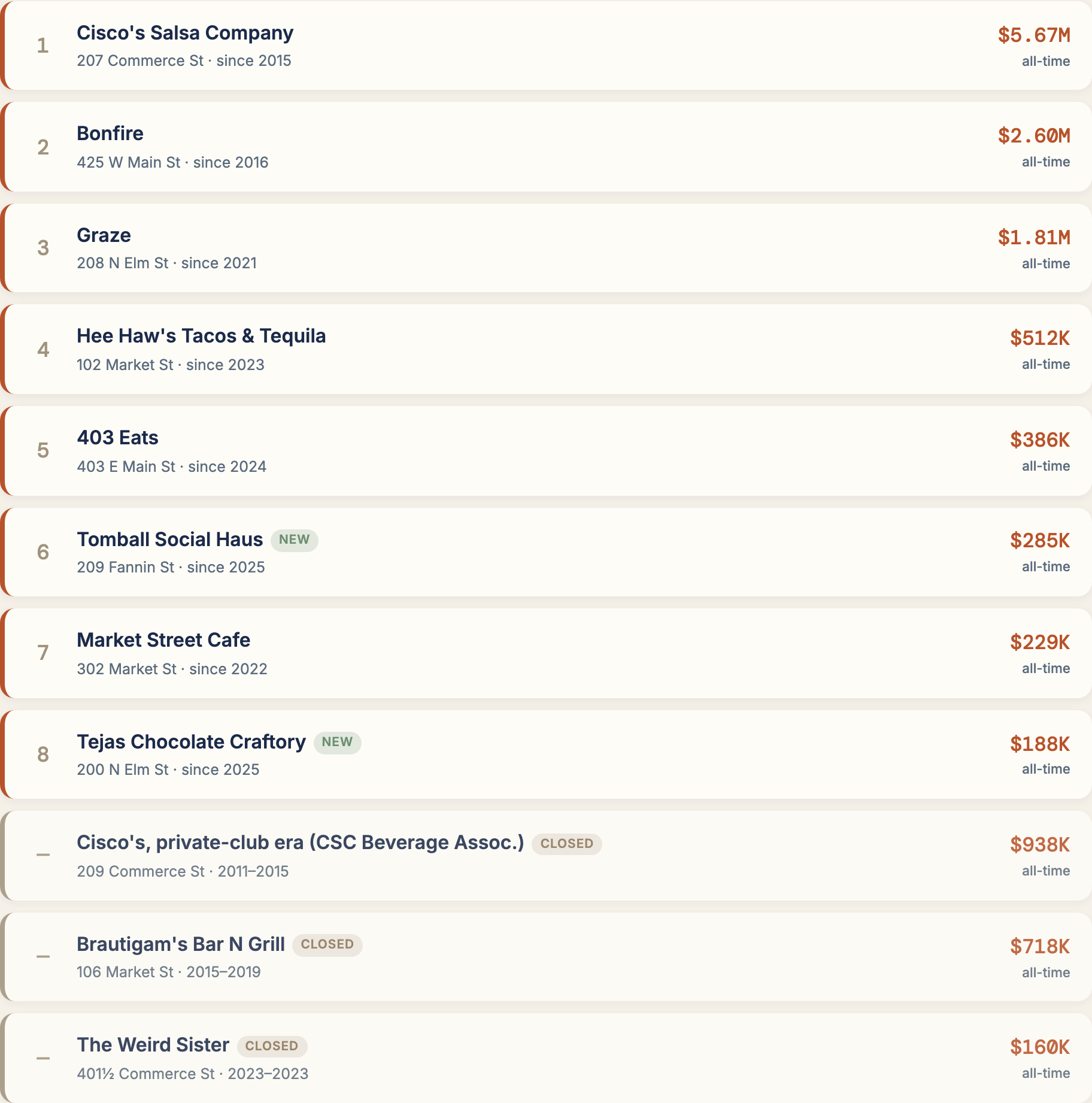
After Cisco’s, the district splits into personalities. Bonfire, in the old firehouse on West Main, is the local wine house: 36% of its sales are wine, versus about 11% district-wide. Graze on North Elm has quietly climbed to third. And newer arrivals are stacking up fast — Hee Haw’s Tacos & Tequila (2023), 403 Eats (2024), and Tomball Social Haus (2025) have all opened in the last few years. 403 Eats is the district’s beer exception: 53% of its sales are suds, the only active Old Town venue where beer outsells spirits in a market that otherwise runs about 63% liquor.
The venues you can’t see
The data has one big blind spot: it only catches mixed-beverage (liquor) permits. Some of Old Town’s most beloved spots pour plenty and report $0 here. Main Street Crossing, the listening room, runs on a beer-and-wine permit, so its drink sales disappear into ordinary confidential sales tax. The Bluebonnet Wine Bar pours wine only, carrying a winery permit rather than a liquor one. Even the German Heritage Festival runs on temporary beer-and-wine permits — so the town’s signature beer event barely registers in two decades of liquor data.
Charming, but not the biggest pour in town
For all the growth, zoom out to the whole city and Old Town turns small. The real volume is out on the Highway 249 corridor, where big sports bars and chains do numbers downtown can’t touch. Over the last two years, Little Woodrow’s (about $7.2M) and District 2.4.9 (about $5.8M) each sold more alcohol than all of Old Town combined. Cisco’s may be the undisputed king of the historic district, but citywide it ranks only around 20th. Of Tomball’s roughly 80 liquor-permitted venues, about 11 sit in Old Town — call it 6.5% of the city’s alcohol sales, packed into a handful of walkable blocks.
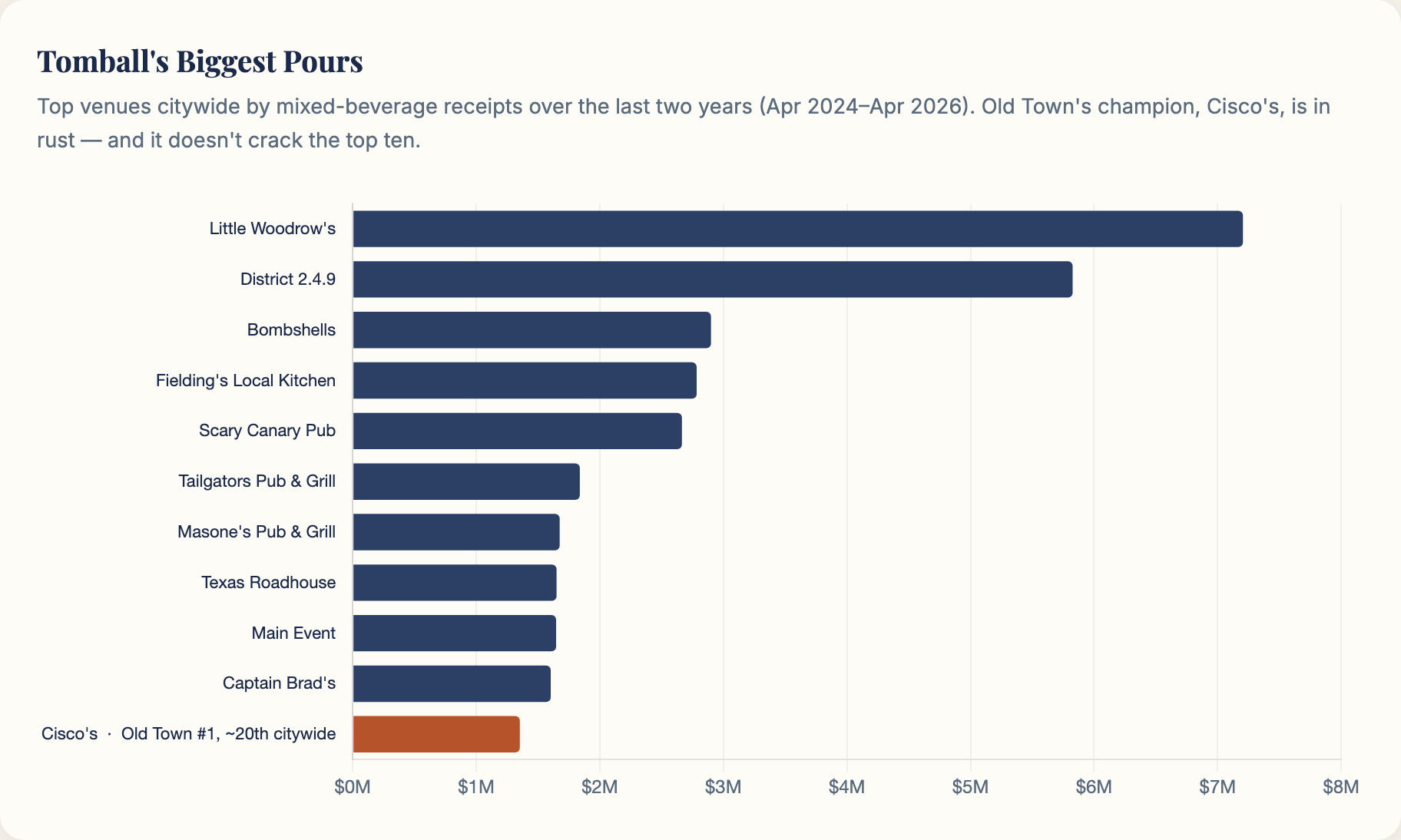
But that was never the point. Old Town isn’t trying to out-pour a highway sports bar; it’s selling something the 249 corridor can’t — a margarita on a hundred-year-old Main Street, a wine bar in a former firehouse, a dozen patios you can walk between on a Friday night. The mixed-beverage ledger just happens to be where that revival shows up in black and white: a flat line for seventy years, and a climb that hasn’t stopped since the day the town voted to lift its own ban. Not bad for eight blocks that, within living memory, couldn’t legally sell you a drink.
Alcohol-sales figures come from the Texas Comptroller’s Mixed Beverage Gross Receipts dataset; “Old Town” is defined as venues in the 77375 historic core along Main (100–700 blocks), Commerce, Market, Elm, and Fannin. Figures are gross receipts reported by each permit holder, not the tax paid. The 1944 ordinance and 2014 election are documented by the Tomball Economic Development Corporation.