Update — July 23, 2026: The city says the mystery is solved. An independent archaeological investigation, funded by the property owner, found no evidence that a cemetery ever existed at 110 N. Walnut Street — the stones were likely rejected or discarded headstones repurposed as construction material many years ago. Not everyone is convinced. Full details just below — our original reporting follows as published.
The verdict: no cemetery — and a theory confirmed
Three weeks after the stones stopped a demolition cold, the City of Tomball announced the answer: there was never a cemetery on the property.
In a statement released July 23, the city said property owner Mitchell Holderrieth engaged a professional archaeologist and funded an independent investigation into whether a historic cemetery existed on the site. The investigation reviewed historical records, government documents, maps, death records, and the physical evidence found at the site — and came back unambiguous.
“The investigation found no evidence that a cemetery ever existed on the property. The report concluded that the headstones found at the site are not associated with burials there. Instead, the evidence indicates they were likely rejected or discarded headstones that were repurposed as construction material many years ago.”
That lands remarkably close to where the skeptics — from Mayor Lori Klein Quinn’s general-store hypothesis to the residents who floated the catalog-headstone theory — had been pointing all along: stones without graves, folded into the block as fill as downtown built over its own past.
The city said residents may notice fencing coming down at the property in the coming days, and stressed that the removal “should not be interpreted as the removal or disturbance of a cemetery.” It thanked Holderrieth for his “cooperation, commitment and professionalism” throughout the process, and the community for its interest.
Not everyone in town is ready to close the book, though. In community discussions since the announcement, some residents have remained skeptical of the official findings. The report itself has not been released publicly, the city’s statement did not name the archaeologist or firm that conducted the investigation, and the names and dates on the stones — the detail that set three weeks of amateur sleuthing in motion — still haven’t been released or publicly matched against the records the investigation reviewed. For a discovery this evocative, a two-paragraph conclusion was never going to satisfy everyone.
Still, the town Ripley’s declared cemetery-free keeps its record intact — and gains one more good story. Whose names are on those stones, and how a batch of century-old rejected headstones ended up under a Walnut Street building, may never be fully answered. Our original reporting on the discovery continues below.
It looked like just another downtown teardown. Then the crews clearing the old furniture store on North Walnut Street started loading debris — and found the stones.
On the morning of Tuesday, June 30, 2026, workers demolishing the aging building at 110 N. Walnut Street, a block off Main, uncovered what appear to be historic headstones. The Tomball Police Department was called just after 10 a.m., fenced off the lot, and pulled the construction permits. More than a century after they were carved, the markers were back in the daylight — in a town that, famously, was never supposed to have a cemetery at all.
What we know
According to the Tomball Police Department’s official release, officers responded at about 10:41 a.m. after a contractor reported “what appeared to be historic cemetery headstones believed to date back to the early 1900s.” The city says the contractor immediately notified officials, and the scene was “locked down while the appropriate historical authorities are contacted.”
Speaking to Houston TV stations at the scene, Capt. Brandon Patin of the Tomball Police Department said the discovery is unlike anything he’s handled.
“I’ve never come across this. So this is different. Our goal is to protect the area until we hear from the historical society, because if it is a cemetery, we want to respect people’s ancestors.”
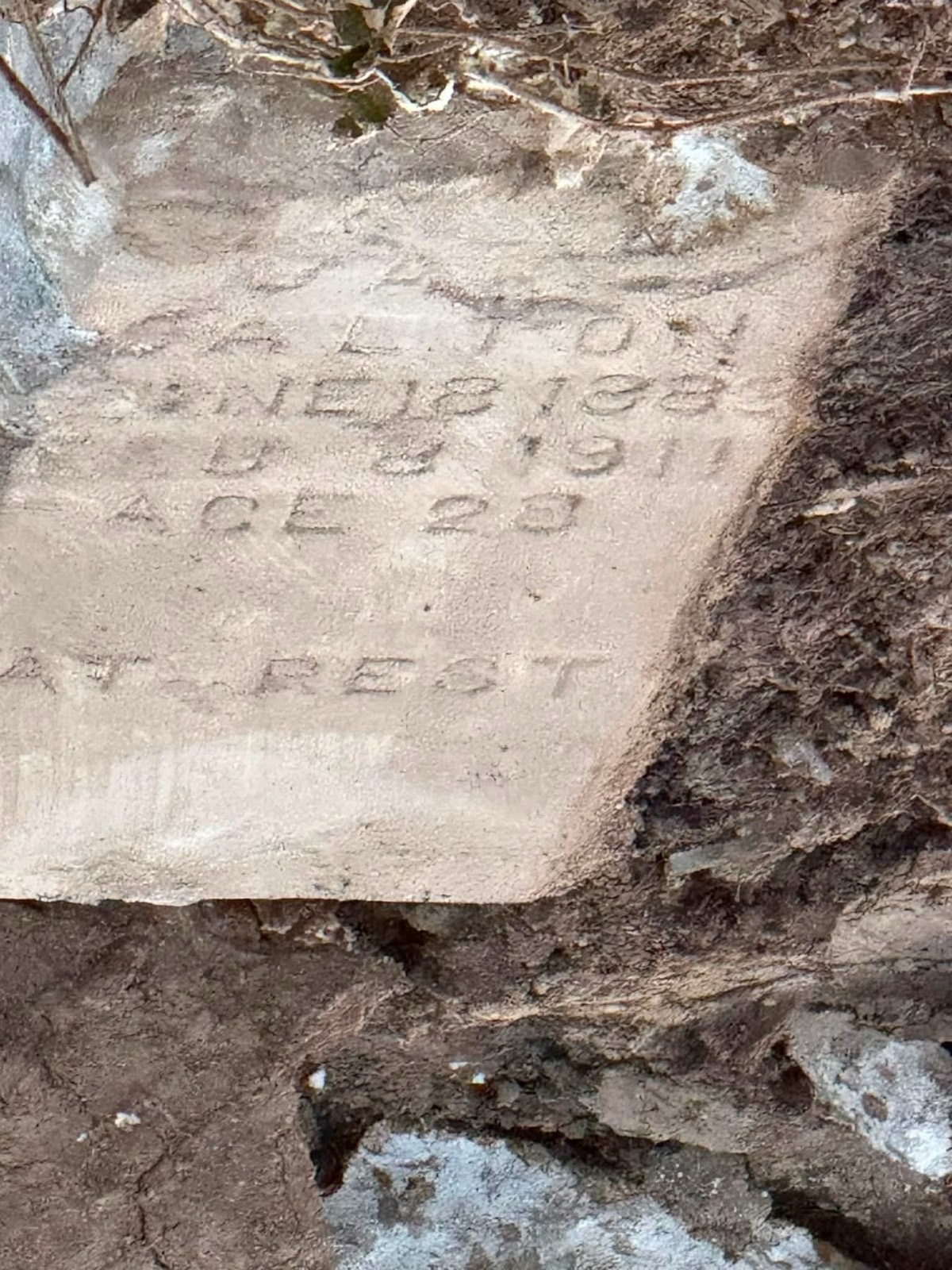
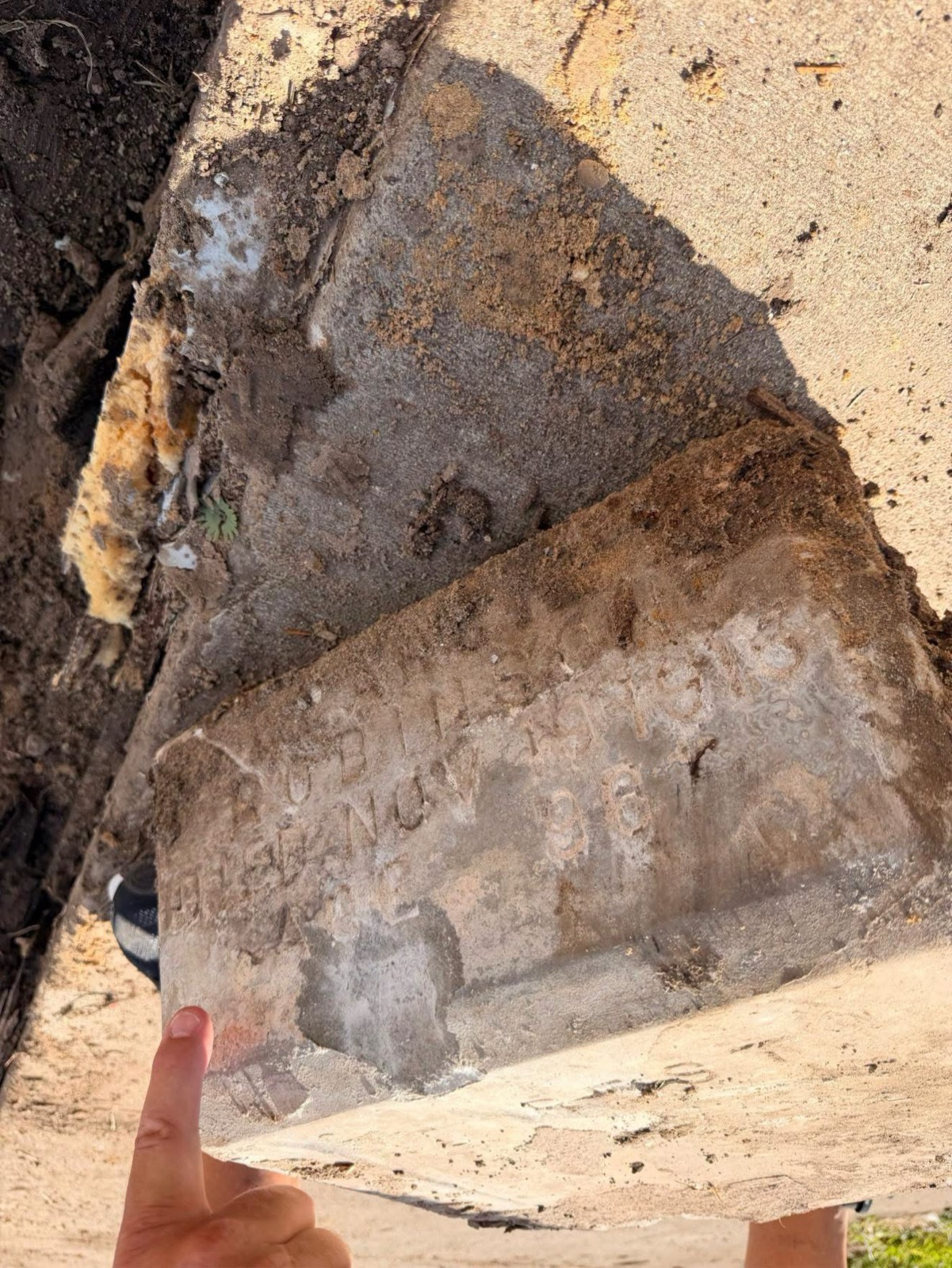
Patin said the markers are inscribed with names and dates from the early 1900s, and that — so far — investigators have not found human remains. “We have not seen any type of bodies, bones, any of that nature,” he said. “Once we saw the stones, we pulled everything off and secured it.”
The carving on the stones is the clearest evidence of what was found, the lettering still legible after all these years:
In a video message to residents, Mayor Lori Klein Quinn confirmed the find and offered the most specific account yet:
“Yes, it’s true. There has been found on Walnut Street … 16 gravestones from 1911 through 1918, and part of a casket. Authorities have been called. The area is cordoned off. This is a very important historical find. … There were people that were buried here.”
The mayor said the state — through the Texas Historical Commission — is expected to take over the assessment, and she asked the public to stay off the property and treat the site with respect. Police say an officer will remain on site 24/7 for the time being.
In a longer sit-down with FOX 26 Houston, Quinn filled in the picture — and, notably, urged caution against jumping to conclusions. She said crews found pieces of tombstones, not intact ones, inscribed with dates ranging from 1911 to 1928, plus “a corner of what appeared to be a casket.” Crucially: “There were no bodies. There were no bones.”
She also raised a possibility that complicates the cemetery story. Holding up what she called the original plat of Tomball, Quinn noted the lot sits inside the town’s original two blocks, once lined with general stores that served the railroad — Hoffman’s Store, Robinson’s Ford — where, she said, “you could go in and buy a casket or a loaf of bread.”
“What if those are gravestones? Are they inventory in the Hoffman store that got buried with development as it got on top of it? There’s no recorded history or records of having any type of cemetery there. … We really don’t know, and because it is our history, we take it very seriously until we do know definite answers.”
Quinn said the landowner is cooperating fully and, at the state’s direction, has engaged an archaeologist; the next steps include surveying and even x-raying the ground to determine what — if anything — lies beneath. She noted the markers themselves still have to be examined by experts to confirm they are truly headstones. The mayor added that a volunteer working to certify a historic Black cemetery in nearby Huffsmith, less than a mile away, is interested in checking whether any names line up once records are released.
The town that “had no cemetery”
Here’s the twist longtime residents keep coming back to: Tomball spent decades known as the town with no cemetery.
The claim was famous enough to land in Robert Ripley’s Believe It or Not! According to A Tribute to Tomball: A Pictorial History of the Tomball Area, longtime postmaster Floyd King Rose once received a letter addressed simply to “Postmaster: Tomball, Texas” from Ripley himself, asking whether the town really had “free water, free gas, and NO cemetery.” Rose confirmed it — and the boast was printed for the nation to read.
The same local history is candid that the reality was messier. Tomball, founded in 1907, never developed the official city cemetery it was supposed to: five acres set aside east of town around 1910 “was never utilized” and reverted to its owner. But the book also records three burial sites within the city over the years — graves that were later moved, or simply built over “because at the time nobody cared,” as one account put it.
In other words: the idea that no one was ever buried in town was always a bit of local mythology. Tuesday’s discovery may be the most vivid reminder yet.
The name on the stone: a Robinson, and a Ford dealership
While officials wait on the state, Tomball’s amateur historians have gone to work — and the most intriguing thread so far starts with a single name.
One of the stones — possibly a footstone — appears to read J. Robinson. Local researchers digging through old records note that J.C. Robinson owned Robinson Ford, Tomball’s first Ford dealership, and that the dealership occupied the northeast corner of West Main at Walnut, with the back of the property running to Commerce Street — in other words, across the street from where the stones surfaced. In 1920 the dealership was sold to the Hohl family and became Hohl Motor Company.
The block’s early landscape is coming into focus too. A two-story hotel known as the Brick Hotel stood across Walnut from the dealership — built, according to one local account, by a Mr. Oppenheimer in 1908, the year after the town was founded. The stones were found not at the hotel site, but beneath a building just north of the old Brick Hotel site, across an alley that splits the block in half.
Before anyone pencils a Robinson into a grave on Walnut Street, though, the same community research cuts the other way: descendants and genealogy-minded residents point out that J.C. Robinson was buried at Forest Park in Houston in 1943 — decades after the dates on the stones, and nowhere near downtown Tomball. If the stone is his family’s, it may mark a different Robinson entirely. Or it may mark no grave at all.
Two more community finds worth noting:
- Old government maps show no cemetery. Residents pulled the 1916 and 1920 USGS maps of Tomball; neither marks a graveyard anywhere in town. Either the surveyors missed it twice, or any burials here were a small private plot — or the stones were never grave markers in place.
- The Sears headstone theory. In the early 1900s, headstones were commonly ordered by catalog through the general store and shipped by rail to the local depot. Several longtime residents suggest the stones could be undelivered or miscarved inventory — display stock or mistakes that were repurposed as fill when the block was built over. It would fit neatly with the mayor’s general-store hypothesis, and with a railroad literally a block away.
None of this is confirmed — it’s the community doing what small towns do, comparing notes in public. But it gives the archaeologists some names and dates to test when the records open up.
The questions everyone’s asking
This is where the confirmed facts run out and the speculation begins — so we’ll be careful to separate the two.
What officials have said: crews found pieces of stone markers inscribed with dates ranging roughly 1911 to 1928, plus a corner of what appeared to be a casket; no bodies or bones have been found; and the state will help determine the site’s significance. (On the casket: several residents say the mayor has since walked that detail back and stated no casket was found. We haven’t been able to confirm a retraction with the city, and we’ll update this story when officials clarify.) What officials have not said: whether this was ever a cemetery at all, whose names are on the stones, how many people (if any) may be buried there, or whether the markers are where they started.
And here’s the wrinkle the mayor herself raised: the lot sat among the town’s original railroad-era general stores — shops that sold caskets and headstones alongside groceries. Could the stones and that casket corner be century-old store inventory, buried as the block was built over, rather than a burial ground? Officials say they genuinely don’t know yet.
Online, residents have floated their own theories: a small family or church plot lost to time, a neglected cemetery quietly built over as the town grew, and more. Some of those ideas may turn out to be right. Right now, none of them are confirmed — the archaeological assessment is only just beginning.
What happens next is largely dictated by state law. If the site is confirmed to be a cemetery, Texas requires the ground be treated with legal protections and coordinated through the Texas Historical Commission — a process that can stretch weeks or months and, in some cases, involve the courts before any further digging. For now, that means the fence, the officer, and the wait.
What’s not in dispute is the tone from the people who live here. As one resident put it to KPRC: “There’s a lot about Tomball’s history we don’t know, and we should move slowly when we think we’re maybe in danger of erasing it.”
What do you think? If your family goes back generations in Tomball, or you’ve heard stories about who might rest near Walnut and Commerce, we’d like to hear from you. Contact us on X at @tomballtimes.
Sources & credits
Reporting compiled from the Tomball Police Department’s public release, Mayor Lori Klein Quinn’s public statement, and coverage by Houston-area stations:
- ABC13 (KTRK)
- FOX 26 Houston
- FOX 26 Houston — Mayor Lori Klein Quinn interview (video)
- KPRC 2
- KHOU 11
- City of Tomball statement
- City of Tomball — July 23 update on the independent investigation (Facebook)
Historical background: A Tribute to Tomball: A Pictorial History of the Tomball Area, via The Portal to Texas History (University of North Texas Libraries). Community research on Robinson Ford, the Hohl family, the Brick Hotel, and early USGS maps was shared publicly in local Tomball history discussions on Facebook; those details are presented as unverified community findings.
Broadcast still frames are included as credited context. Scene and headstone photos were shared within the Tomball community; if you took one of these images and would like a different credit or its removal, please contact us.